# Transaction Cost Analysis

<figure><img src="/files/0eyBm5E3FCiparFbS3MO" alt=""><figcaption></figcaption></figure>

<figure><img src="/files/XMK64WwxF4F7CyJDDrbL" alt=""><figcaption></figcaption></figure>

## Filters

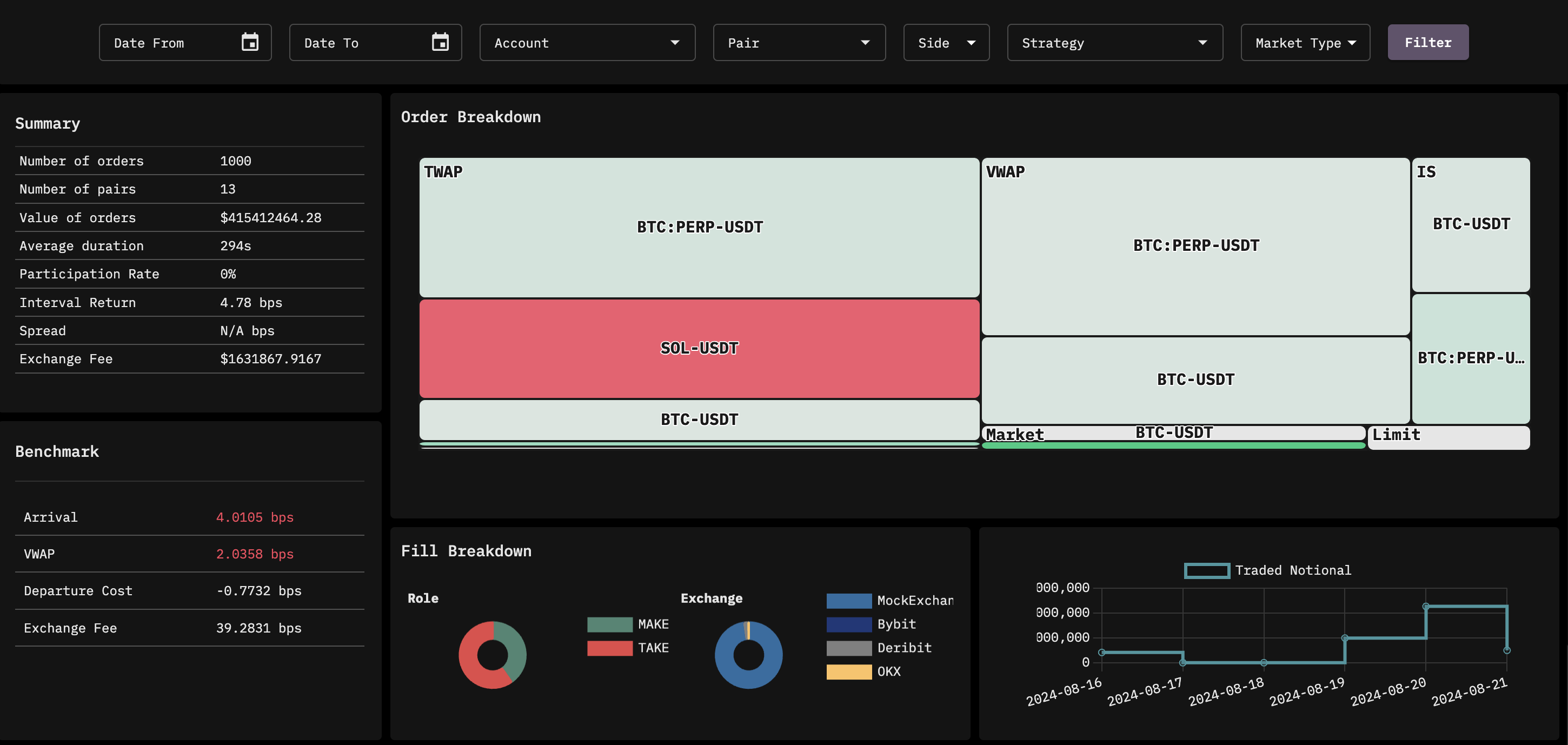
The filter fields (date, account, pair, side, and strategy, and market type) at the top of the page apply to all the data visualizations on this page.&#x20;

## Summary

<table><thead><tr><th width="194">Field</th><th>Details</th></tr></thead><tbody><tr><td>Number of Orders</td><td>Number of orders</td></tr><tr><td>Number of Pairs</td><td>Number of unique pairs traded</td></tr><tr><td>Value of Orders</td><td>Sum of notional traded value of orders</td></tr><tr><td>Average Duration</td><td>Notionally weighted average of order duration</td></tr><tr><td>Participation Rate</td><td>Share weighted average of <em>executed quantity / market volume</em></td></tr><tr><td>Interval Return</td><td>Notionally weighted average log return of <em>arrival price vs departure price</em></td></tr><tr><td>Spread</td><td>Notionally weighted average spread of name</td></tr><tr><td>Exchange Fee</td><td>Sum of notional exchange fees </td></tr></tbody></table>

## Order Breakdown

Notional breakdown of each token bought/sold and strategy used, colored by the notionally-weighted arrival slippage.

## Fill Breakdown

* Notional breakdown of fills that acted as maker or taker across all orders
* Notional breakdown of exchanges that were used

## Timeseries Traded Notional

Shows the total notional traded by day of order entry

## Benchmark Costs

For all costs, negative (green) means the algorithm beat the benchmark and positive (red) means the algorithm incurred costs relative to each benchmark.

<table><thead><tr><th width="186">Field</th><th>Details</th></tr></thead><tbody><tr><td>Arrival Cost</td><td>Notionally-weighted, side-adjusted natural logarithm of <em>executed price</em> divided by <em>arrival price</em>. Arrival cost can show the shortfall in prices between the investment decision and execution.  </td></tr><tr><td>VWAP Cost</td><td>Notionally-weighted, side-adjusted natural logarithm of <em>executed price</em> divided by <em>VWAP</em>. VWAP costs can show how well the algorithm tracked market volume and show relative fill quality versus the weighted average price of the market during the order duration. </td></tr><tr><td>Departure Cost</td><td>Notionally-weighted, side-adjusted natural logarithm of <em>executed price</em> divided by <em>departure (last) price</em>. </td></tr><tr><td>Exchange Fee</td><td>Notionally-weighted <em>exchange fee</em> divided by <em>traded notional</em>. This shows the average exchange fee paid to help monitor exchange fee benefits.</td></tr></tbody></table>

## Order Size Distribution

A histogram of the number of orders, broken out by side, in a range of notional value or participation rate buckets.

## Arrival Slippage

A visualization of the distribution of orders' slippage from arrival price, normalized as a z-score, that is, the number of standard deviations away from the mean arrival slippage.

## VWAP Slippage

A visualization of the distribution of orders' slippage from VWAP, normalized as a z-score, that is, the number of standard deviations away from the mean VWAP slippage.


---

# Agent Instructions: Querying This Documentation

If you need additional information that is not directly available in this page, you can query the documentation dynamically by asking a question.

Perform an HTTP GET request on the current page URL with the `ask` query parameter:

```
GET https://docs.tread.fi/other-features/transaction-cost-analysis.md?ask=<question>
```

The question should be specific, self-contained, and written in natural language.
The response will contain a direct answer to the question and relevant excerpts and sources from the documentation.

Use this mechanism when the answer is not explicitly present in the current page, you need clarification or additional context, or you want to retrieve related documentation sections.